

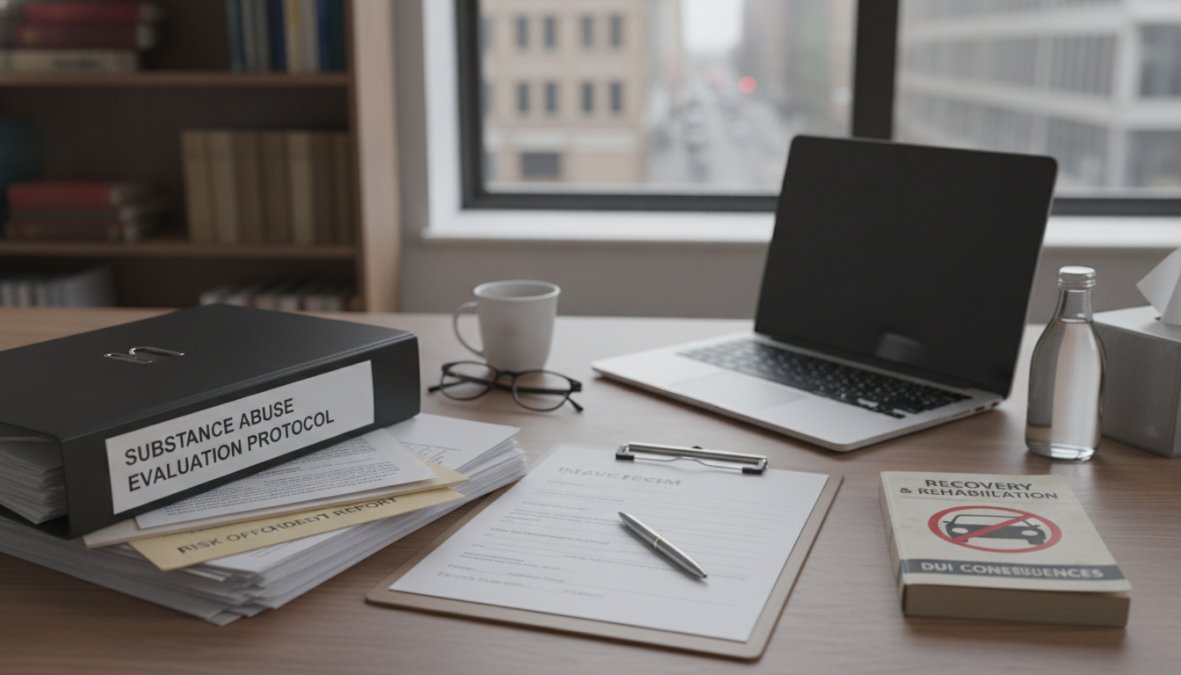
Substance Abuse Evaluation for DUI Charges: Complete Guide
Understand substance abuse evaluation for DUI charges. Learn what to expect, how to prepare, and next steps after assessment. Start your evaluation today.
Last Updated: June 19, 2026
Getting a DUI charge is stressful. Then the court requires a substance abuse evaluation before anything else moves forward. This guide breaks down exactly what that evaluation involves, why courts require it, and how to get through it efficiently. We’ll walk you through the full process from intake to post-evaluation compliance, including how to appeal an evaluation result and how to choose between remote and in-person formats.
Here’s what most people get wrong: a substance abuse evaluation isn’t a test you pass or fail. It’s a clinical assessment designed to match your situation to the right level of care, if any is needed.
What Is a Substance Abuse Evaluation for DUI Charges?
A substance abuse evaluation for DUI charges is a structured clinical assessment conducted by a licensed counselor to determine whether an individual’s alcohol or drug use indicates dependency, a substance use disorder, or elevated risk factors requiring intervention. Courts order this assessment as a condition of legal compliance following a DUI or DWI conviction.
The evaluation produces a formal report that the court, your probation officer, or the DMV uses to determine next steps: mandatory education, counseling, a structured treatment plan, or documentation that no further intervention is needed. The report is not a verdict on your character. It’s a clinical tool.
The evaluation’s findings directly influence sentencing outcomes, driver’s license reinstatement timelines, and probation requirements. A thorough, honest evaluation completed promptly can work in your favor during court proceedings.
Why Is a Substance Abuse Evaluation Required After a DUI?
Courts require a substance abuse evaluation after a DUI because a traffic violation and a substance use disorder require fundamentally different responses. The legal system recognizes that treating every DUI as a simple traffic matter misses individuals who would benefit from early intervention.
The requirement exists for several reasons:
- Legal compliance: State statute in most jurisdictions mandates an evaluation as a condition of sentencing, probation, or license reinstatement
- Risk assessment: Courts need clinical data to determine whether the individual poses an ongoing public safety risk
- Treatment referral: The evaluation identifies whether mandatory education, outpatient counseling, or more intensive treatment is appropriate
- Compliance monitoring: The resulting report creates a documented baseline that probation officers and courts can reference throughout the case
A DUI assessment also serves the individual. Many people who receive a DUI are not dependent on alcohol or drugs, and a clean evaluation report reflects that clearly. For those who do show signs of a substance use disorder, early identification and structured treatment produce significantly better long-term outcomes.
The substance abuse evaluation is not adversarial. Approaching it honestly and completely is the single most effective strategy for a favorable outcome.
DUI Assessment Questions: What You’ll Be Asked
The DUI assessment covers more ground than most people expect. Evaluators build a comprehensive picture of your relationship with alcohol and substances over time.

Initial Intake and Psychosocial History
The intake phase collects background information through forms covering your personal history, family background, employment, legal history, and substance use timeline. This psychosocial history forms the foundation of the entire evaluation.
Expect this phase to take 10 to 20 minutes. Be specific and accurate. Vague answers create ambiguity in the report.
Alcohol Screening and Drug Assessment
The alcohol screening and drug assessment phase uses validated clinical tools to measure the nature and severity of your substance use. Common instruments include standardized questionnaires assessing consumption patterns, dependency indicators, and behavioral consequences.
Some evaluations also include a urine drug screen or breathalyzer, depending on court requirements and the evaluating agency’s protocol. This phase typically takes 15 to 30 minutes.
Mental Health Screening
Mental health screening identifies signs of anxiety, depression, PTSD, or other conditions that may influence substance use behavior. This isn’t a full psychiatric evaluation but a screening to flag whether additional mental health services are warranted. If you have a diagnosed condition, disclose it.
Court-Ordered Substance Abuse Evaluation Preparation
Preparation is where most people either help themselves or inadvertently hurt themselves.

Documents to Bring
Arriving prepared signals cooperation and speeds up the intake process. Bring:
- Government-issued photo ID (driver’s license or passport)
- Court order or referral documentation specifying the evaluation requirement
- Insurance card, if applicable
- List of current medications with dosages
- Any prior treatment records or previous evaluation reports
- Probation officer’s contact information, if applicable
If completing the evaluation online through DrugEval.com, most documents can be uploaded securely through encrypted intake forms before your session begins.
What Not to Do Before Your Evaluation
- Do not consume alcohol or substances in the 24-48 hours before your evaluation. Impaired judgment during the interview will show.
- Do not rehearse scripted answers. Evaluators recognize rehearsed responses and they create doubt about your honesty.
- Do not arrive late or reschedule without notice. Courts view non-compliance with evaluation requirements as a red flag.
- Do not bring someone into the session with you. The clinical interview requires candor that’s harder to achieve with an audience.
Review your own timeline before the session. Think through your actual history with alcohol and substances. Honest self-reflection before the interview produces clearer, more consistent answers during it.
What Happens After a Substance Abuse Evaluation for DUI
What happens after a substance abuse evaluation for DUI charges is arguably more consequential than the evaluation itself.
Treatment Referral and Probation Requirements
The evaluation report places you into one of several outcome categories:
- No diagnosis, education recommended: The evaluator finds no clinical indicators of dependency or disorder but recommends a DUI education program as a preventive measure. This is a common outcome for first-time offenders.
- Substance use disorder identified, outpatient treatment recommended: The evaluator identifies patterns consistent with a substance use disorder and recommends structured outpatient counseling or an intensive outpatient program (IOP).
- Severe dependency identified, residential treatment recommended: Applicable when the evaluation reveals significant dependency or prior treatment failures.
The report goes directly to the court, your probation officer, or the DMV. From there, compliance monitoring begins. Failure to meet probation deadlines carries real legal consequences.
Post-Evaluation Roadmap and Compliance Monitoring
Here’s a practical roadmap for the 90 days following your evaluation:
- Receive and review your report
- Submit the report to the court or DMV as required
- Enroll in any recommended program within the timeframe specified by the court
- Attend all scheduled sessions and obtain documentation of attendance
- Provide proof of completion to your probation officer or the court
- Request a compliance letter from your treatment provider upon finishing
- Follow up on driver’s license reinstatement once all requirements are documented
If you believe your evaluation report contains errors or doesn’t accurately reflect your situation, you have the right to request a review or a second evaluation. Contact the evaluating agency first; if that doesn’t resolve the issue, your attorney can petition the court for a second opinion from a different court-approved evaluator.
Remote vs. In-Person Evaluations: Which Is Right for You?
The choice between remote and in-person evaluation is more consequential than most people realize. Both formats are clinically valid, but they’re not identical experiences.
| Factor | Remote (Telehealth) | In-Person |
|---|---|---|
| Scheduling flexibility | High | Limited to office hours |
| Travel requirement | None | Required |
| Privacy | High (home environment) | Shared waiting room |
| Turnaround time | Often faster | Varies by provider |
| Court acceptance | Accepted in most jurisdictions | Universally accepted |
| Technology requirement | Stable internet, webcam | None |
Remote evaluations are the right choice for most people. The clinical quality is equivalent when conducted by a licensed counselor with IC&RC or affiliated board credentials, and the convenience factor is significant.
Confirm that your specific court or jurisdiction accepts telehealth evaluations before booking. Most do, but state statutes vary.
DrugEval.com operates as a fully online platform built specifically for this situation. Appointments can be booked in 60 seconds, sessions are conducted via encrypted telehealth, and the resulting reports are court-ready. Counselors hold IC&RC or affiliated board credentials with an average of five or more years of experience.
For individuals subject to DOT SAP requirements following a workplace drug test, DrugEval.com offers DOT SAP evaluations conducted by DOT-qualified SAPs to meet federal standards.
The bottom line: remote works for most people, in-person is never wrong, and the credential of the evaluator matters more than either.
Facing a DUI charge means managing legal pressure, administrative deadlines, and clinical requirements simultaneously. DrugEval.com makes the evaluation step significantly simpler: a 100% online process, licensed counselors with IC&RC credentials, encrypted intake forms, and court-ready reports delivered with fast turnaround times. Book your evaluation at DrugEval.com and get the compliant report you need without the delays that make a difficult situation worse.
Frequently Asked Questions
What questions are asked during a substance abuse evaluation for DUI charges?
A substance abuse evaluation typically includes questions about your drinking or drug use history, frequency and quantity of use, family history of addiction, mental health symptoms, legal history, and how substance use has affected your work, relationships, and driving. The clinical assessment may also include standardized screening tools to assess risk factors and dependency levels. Questions are designed to help the evaluator create an accurate clinical diagnosis and treatment plan tailored to your needs.
How long does a substance abuse evaluation take?
Most substance abuse evaluations take between 45-90 minutes, though some may be shorter or longer depending on complexity. The duration includes the clinical interview, psychosocial history review, alcohol screening, drug assessment, mental health screening, and completion of required paperwork. Online evaluations through platforms like DrugEval.com can often be scheduled more flexibly, allowing you to complete your assessment without lengthy wait times for in-person appointments.
What happens after my substance abuse evaluation for a DUI?
After your evaluation, you’ll receive a comprehensive report with the evaluator’s clinical diagnosis, risk assessment, and treatment referral recommendations. This report goes to the court or probation officer overseeing your case. You may be required to complete mandatory education programs, participate in counseling, or enter treatment based on the findings. Your post-evaluation roadmap will outline specific probation requirements and compliance monitoring steps you must follow to meet legal obligations.
Can I appeal the results of a substance abuse evaluation?
Yes, you typically have the right to request a second evaluation or appeal the findings through your attorney if you believe the assessment was inaccurate or unfair. The evaluation appeal process varies by state statute and court jurisdiction. It’s important to discuss any concerns about your evaluation results with your legal counsel immediately. Some individuals pursue a second clinical assessment to present alternative findings, though courts generally give significant weight to the original court-approved evaluation.
Ready to book your evaluation?
It’s confidential and takes about 60 seconds to get matched to the right evaluation and a qualified substance abuse professional.
Find My Evaluation

