

Court-Ordered Drug Test vs Evaluation: Key Differences
Understand court-ordered drug test vs evaluation differences. Learn what each involves, legal requirements, and how to prepare. Start your assessment.
Last Updated: July 6, 2026
Understanding the distinction between a court ordered drug test vs evaluation is critical for anyone facing legal mandates. While these terms are often used interchangeably, they represent fundamentally different procedures with distinct purposes, processes, and legal implications. A drug test answers one simple question (“Is this substance present?”), while a substance abuse evaluation answers a far more complex question (“Does this person have a substance use disorder, and if so, what level of treatment do they need?”).
According to SAMHSA’s substance use disorder treatment guidance, the clinical assessment process follows structured diagnostic criteria that go far beyond simple drug detection. Courts increasingly order evaluations rather than tests alone because they need comprehensive clinical data to make informed sentencing and treatment recommendations.
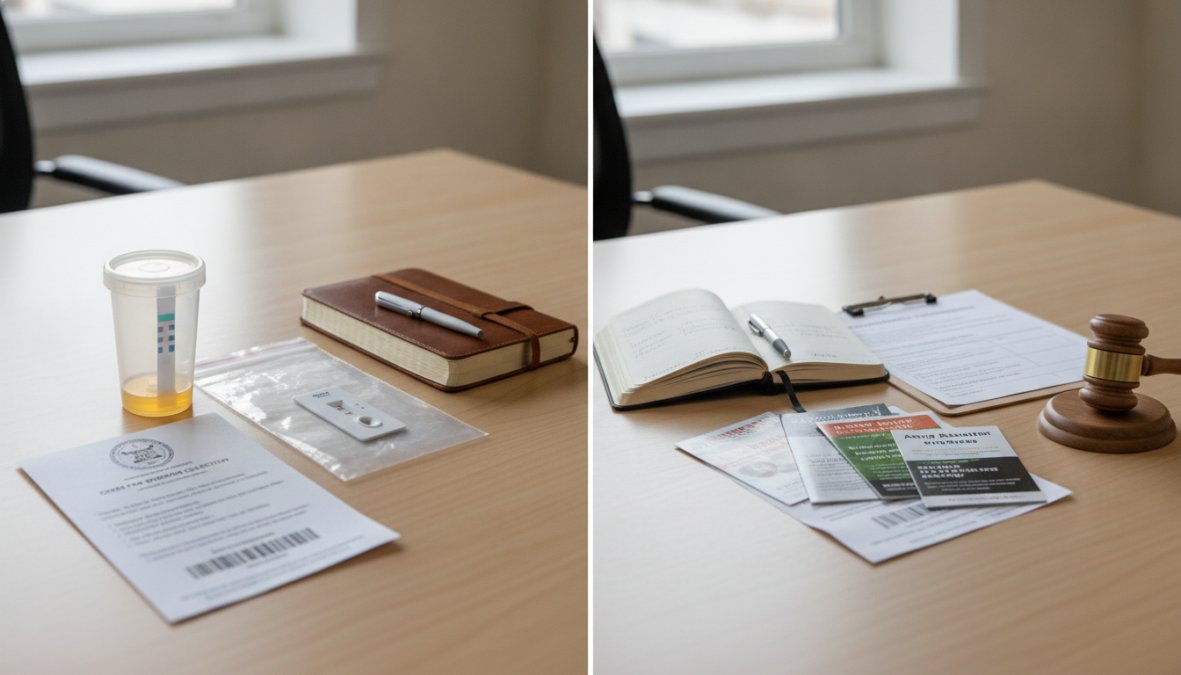
A drug test detects the presence of substances. An evaluation diagnoses substance use disorders and recommends treatment. Courts often order both, but they serve different legal purposes.
What Is a Court-Ordered Drug Test?
A court-ordered drug test is a straightforward biological screening that identifies whether specific substances are present in your system. Typical panels include 5-panel (cocaine, marijuana, amphetamines, opioids, PCP), 10-panel (adds benzodiazepines, barbiturates, methadone, propoxyphene), or specialized alcohol tests like EtG (ethyl glucuronide) that detect alcohol consumption within the past 80 hours.
The collection process is standardized and rapid. You provide a urine sample, blood sample, or saliva specimen depending on what the court specifies. Chain-of-custody procedures ensure legal defensibility. Results typically come back within 24-72 hours as a positive or negative report.
Courts order drug tests for compliance monitoring: probation check-ins, custody disputes, DUI cases requiring ongoing monitoring, or conditions of bond. The test answers whether you’ve violated a substance-specific court order. It does not assess your mental health, treatment needs, or addiction severity.
Most jurisdictions contract with established testing networks that maintain collection sites in every county. You schedule an appointment, provide the sample, and receive results within days. Turnaround is fast because there’s no clinical interview or diagnostic assessment.
What Is a Substance Abuse Evaluation?
A substance abuse evaluation is a comprehensive clinical assessment conducted by a licensed counselor, clinical social worker, or addiction specialist. It generates a diagnostic report that includes your substance use history, mental health screening, social and family context, legal history, employment status, and specific clinical recommendations for treatment.
The evaluation follows the ASAM (American Society of Addiction Medicine) criteria, a nationally recognized diagnostic framework. ASAM assesses six dimensions: acute intoxication and withdrawal potential, biomedical conditions and complications, emotional/behavioral conditions and complications, readiness to change, relapse/continued use potential, and recovery environment. Based on this assessment, the evaluator assigns a level of care recommendation: abstinence-based outpatient, intensive outpatient, residential/inpatient, or medically monitored intensive inpatient.
The clinical interview is the core of the evaluation. You’ll discuss your substance use timeline, family history of addiction, previous treatment attempts, mental health diagnoses, employment, legal involvement, and social support systems. This interview typically lasts 45-120 minutes.
The evaluation produces a formal report that courts, probation officers, and treatment providers rely on for sentencing recommendations, treatment planning, and ongoing case management. It answers clinical questions: Is treatment necessary? What level? What specific modalities (individual counseling, group therapy, medication-assisted treatment)? Are there co-occurring mental health conditions requiring integrated treatment?
Evaluations often reveal underlying mental health conditions (depression, anxiety, trauma) that weren’t initially apparent. This dual diagnosis changes treatment strategy significantly. Courts take these findings seriously because untreated mental illness drives relapse.
Why Courts Order Drug Tests and Evaluations
Courts order both procedures for distinct but complementary reasons. Drug tests serve compliance monitoring, they verify adherence to court-ordered abstinence and are frequent and routine, sometimes monthly or quarterly throughout probation. A positive test result triggers immediate legal consequences.
Evaluations serve diagnostic and sentencing purposes. A judge orders an evaluation early in the legal process to understand your substance use severity and treatment needs before deciding on sentencing, probation conditions, or treatment mandates. The evaluation informs the entire case trajectory.
Many jurisdictions require both. The typical sequence is: arrest or conviction → court orders evaluation → evaluation results guide sentencing → probation conditions include periodic drug tests. The evaluation happens once; drug tests continue throughout the probation period.
Research from NIJ criminal justice substance abuse treatment research shows that comprehensive assessments combined with ongoing monitoring produce better long-term outcomes than testing alone. The legal mandate for an evaluation typically comes with a deadline: 30, 60, or 90 days to complete it. Missing that deadline can result in contempt of court charges.
What to Expect at a Drug and Alcohol Assessment
The substance abuse evaluation begins with intake paperwork covering your substance use history, medical history, psychiatric history, family background, employment, legal history, and social support. This takes 20-30 minutes and sets the stage for the clinical interview.

The clinical interview follows with open-ended questions about your substance use: when you started, what you’ve used, how frequently, consequences you’ve experienced, previous treatment attempts, triggers for use, and your current motivation for change. Mental health screening is integrated throughout, assessing for depression, anxiety, trauma history, suicidal ideation, and other psychiatric conditions.
The evaluator also explores your social environment: family support, employment, housing, peer relationships, and community involvement. Recovery doesn’t happen in isolation; your environment either supports or undermines sobriety. By the end of the interview, the evaluator has gathered enough information to assign ASAM levels and make treatment recommendations. Within 5-10 business days, you receive the formal written report, which is sent to the court, your attorney, and your probation officer.
The Clinical Interview Process
The clinical interview is conversational, not interrogatory. The evaluator is building a clinical picture, and that requires honesty. Substance abuse evaluations are protected by confidentiality laws (with limited exceptions for imminent danger or child abuse). What you disclose cannot be used against you in criminal proceedings.
Be specific about timelines and quantities. Vague answers are less clinically useful than concrete ones. Expect questions about your motivation for change. Both external motivation (legal pressure) and internal motivation (personal desire) are valid clinically. Honesty about your current motivation is more useful than claiming sudden epiphany.
If you’ve been to rehab, counseling, or 12-step programs before, the evaluator wants to know what worked, what didn’t, why you left, and what you learned. Relapse is common and not a clinical failure; it’s data that helps your current treatment plan address triggers.
Psychosocial Assessment and ASAM Criteria
The ASAM criteria structure the entire evaluation. Rather than a simple “addiction” or “no addiction” binary, ASAM recognizes that substance use disorders exist on a spectrum of severity and that treatment intensity should match that severity.
ASAM Level 0.5 is brief intervention for mild substance use with strong protective factors. Level 1 is outpatient treatment: 1-2 sessions weekly. Level 2 is intensive outpatient: 9+ hours weekly, often for moderate severity or failed outpatient attempts. Level 3 is residential or inpatient treatment: 24-hour care for severe substance use disorders or co-occurring psychiatric conditions. Level 4 is medically managed intensive inpatient treatment for acute medical or psychiatric crises.
The evaluator assesses your situation across all six ASAM dimensions and assigns a level. A person with moderate cocaine use but severe depression might be assigned Level 2 rather than Level 1 because the co-occurring depression requires more intensive treatment coordination. Courts use these recommendations to structure probation conditions.
How to Prepare for a Court-Ordered Substance Abuse Evaluation
Gather your medical and psychiatric history. Bring a list of current medications, previous mental health diagnoses, and significant medical conditions. If you have previous treatment records, bring those too.
Be honest about your substance use history. The evaluator isn’t there to prosecute you; they’re there to help. Minimizing or hiding information undermines the clinical process. The more honest you are, the more accurate the assessment and the better the treatment recommendations.
Arrange transportation and schedule the evaluation early. Missing the court-ordered deadline is a serious problem. Many evaluators offer telehealth sessions, which eliminates transportation barriers. At DrugEval.com, Court or Probation evaluations are conducted 100% online via secure video sessions with licensed counselors. You can complete your evaluation from home while maintaining full confidentiality and meeting your court deadline.
Bring a government-issued ID and proof of your court order. Some evaluators may request employment verification or proof of residence. Avoid substances immediately before your evaluation to ensure clarity during the interview.
Consequences of Failing a Court-Ordered Drug Test
Failing a court-ordered drug test triggers immediate legal consequences. A single positive test doesn’t automatically mean probation revocation, but it’s treated seriously. Your probation officer will document the failure. If it’s your first positive, you may receive a warning or be ordered into treatment. Multiple positives make revocation likely.
The legal process following a positive test typically involves a probation violation hearing. You have the right to contest the result by requesting a confirmatory test, challenging the chain of custody, or arguing that the positive resulted from prescribed medication. However, the burden of proof is lower in probation proceedings than in criminal trials.
Consequences escalate with repeated failures. A second or third positive often results in increased conditions (more frequent testing, residential treatment, electronic monitoring) or probation revocation and incarceration. Courts view repeated positive tests as evidence that your current supervision level isn’t working.
A failed drug test while on probation can result in immediate arrest and incarceration pending a violation hearing. If you’re struggling with substance use, request treatment immediately rather than waiting for a positive test.
Timeline and Compliance: How Long Does Assessment Take?
A substance abuse evaluation typically takes 2-3 hours from start to finish. Intake paperwork: 20-30 minutes. Clinical interview: 60-120 minutes. Psychological screening and ASAM assessment: 20-30 minutes. Turnaround for the written report is usually 5-10 business days.
Court deadlines for evaluation completion are typically 30-60 days from the date the order is issued. Meeting that deadline is mandatory. Schedule your evaluation early; don’t wait until day 25 of a 30-day deadline.
Drug tests are much faster. Collection takes 5-10 minutes. Results come back within 24-72 hours. You typically don’t know your test date in advance; your probation officer calls and tells you to report within 24 hours. This random scheduling prevents timing substance use around test dates.
The frequency of drug tests varies by jurisdiction and probation conditions. Some people test monthly, others weekly or more frequently. Online evaluations through platforms offering Court or Probation evaluations can be scheduled quickly and completed on your timeline, with reports typically ready within 5-7 business days.
Post-Evaluation Legal Strategy and Treatment Recommendations
Once your evaluation report is complete, it becomes part of the court record and shapes your legal path forward. If the evaluator’s recommendations align with your situation, your next step is straightforward: comply with the recommended treatment level. Enroll in the recommended program, attend sessions consistently, and document your participation. Courts view treatment compliance as evidence of rehabilitation.
If the evaluation recommends a treatment level you believe is inappropriate, you can request a second evaluation from a different clinician or present the evaluation to your attorney to discuss challenging it in court.
The evaluation becomes relevant if you’re considering probation modification or early termination. Demonstrating consistent treatment participation, sobriety via negative drug tests, and lifestyle changes strengthens your case for reduced conditions.
Co-occurring mental health conditions identified in the evaluation require integrated treatment. If the evaluation found depression or PTSD alongside substance use, your treatment plan should address both. Integrated treatment has better outcomes than substance use treatment alone.
If the evaluation recommends medication-assisted treatment (MAT) for opioid use disorder, that becomes part of your legal obligations. Enrolling in MAT and maintaining medication compliance is typically a condition of probation. The evaluator may also recommend family counseling or other psychosocial interventions. These are clinical recommendations that courts expect you to pursue.
Understanding the difference between a court ordered drug test vs evaluation helps you navigate the legal system more effectively. A drug test is a compliance tool; an evaluation is a diagnostic and treatment-planning tool. Courts use both because they serve different purposes. Your evaluation report becomes a roadmap for your treatment and recovery. Completing it honestly, engaging with the recommended treatment, and maintaining compliance with drug testing requirements demonstrates to the court that you’re committed to change. If you’re facing a court-ordered evaluation, getting started early removes uncertainty and stress. Schedule your Court or Probation evaluation with DrugEval.com and connect with a licensed counselor who can guide you through the process with professionalism and confidentiality.
Frequently Asked Questions
Is a drug evaluation the same as a drug test?
No. A drug test (urinalysis or blood test) detects the presence of substances in your system at a specific moment. A substance abuse evaluation is a comprehensive clinical interview and psychosocial assessment that examines your substance use history, co-occurring disorders, and need for treatment. Courts often order both to get a complete picture of compliance and clinical needs.
What happens during a court-ordered drug evaluation?
A court-ordered substance abuse evaluation includes a detailed clinical interview, review of your substance use history, assessment using ASAM criteria, and evaluation for co-occurring mental health disorders. A licensed counselor or DOT SAP will create a diagnostic report with treatment recommendations tailored to your situation. The entire process is typically conducted confidentially and documented for court submission.
How long does a court-ordered drug evaluation take?
Most substance abuse evaluations take 60-90 minutes for the clinical interview and assessment. With online platforms like DrugEval.com, you can book your appointment in 60 seconds and complete the evaluation via secure telehealth. Turnaround for a court-ready report is typically 24-48 hours, depending on your jurisdiction’s requirements.
What are the consequences of failing a court-ordered drug test?
Failing a court-ordered drug test can result in probation violation charges, increased court supervision, mandatory treatment or counseling, extended probation periods, jail time, or loss of custody rights, depending on your case and jurisdiction. A positive result may also trigger a more comprehensive substance abuse evaluation to assess treatment needs and severity.
Can I appeal an unfavorable substance abuse evaluation?
Yes, you may appeal or request a second evaluation in many jurisdictions, especially if you believe the assessment was inaccurate or unfair. Documenting any concerns during your evaluation and consulting with your attorney about post-evaluation legal strategy can help. Some courts allow defendants to obtain an independent evaluation to challenge the original findings.
Ready to book your evaluation?
It’s confidential and takes about 60 seconds to get matched to the right evaluation and a qualified substance abuse professional.
Find My Evaluation

