


Court-Ordered Substance Abuse Evaluation Cost: 2026 Guide
Understand court-ordered substance abuse evaluation costs, factors affecting pricing, and what to expect. Learn how to prepare and find approved providers.
Last Updated: July 3, 2026
Understanding court-ordered substance abuse evaluation costs is essential when facing legal assessment requirements. Many individuals don’t know what to expect financially, how the process works, or where to find qualified providers. At DrugEval.com, we help people navigate this with clear information about pricing, what the evaluation involves, and how to prepare.
What Is a Court-Ordered Substance Abuse Evaluation?
A court-ordered substance abuse evaluation is a comprehensive clinical assessment conducted by a licensed professional to determine whether an individual has a substance use disorder. Courts mandate these evaluations in cases involving DUI/DWI charges, probation violations, custody disputes, or criminal sentencing. The evaluation produces a formal report documenting findings, diagnostic impressions, and treatment recommendations that inform sentencing and probation conditions.
The evaluation follows standardized protocols, includes clinical interviews, standardized testing, and psychosocial assessment. Licensed counselors or psychologists conduct these evaluations, and they must be court-approved providers in your jurisdiction.
Court-approved providers typically hold credentials like IC&RC certification or state licensure in counseling. Verify your provider’s credentials before scheduling.
Court-Ordered Substance Abuse Evaluation Cost: Pricing Breakdown
Court-ordered substance abuse evaluation costs vary significantly based on location, provider credentials, evaluation complexity, and delivery method (in-person or online). Most evaluations range from $300-$1,500, though insurance and sliding-scale options can reduce costs.
For fast, compliant assessments, Court or Probation evaluations through DrugEval.com offer online evaluations with flat-rate pricing and same-day scheduling. The platform connects you with state-licensed counselors who deliver court-ready reports without delays.
Factors That Influence Evaluation Costs
Provider Type and Credentials. Licensed clinical social workers, addiction counselors, and psychologists charge different rates. Providers with advanced credentials (master’s degree, doctoral degree, IC&RC certification) typically charge more. What matters is that your provider is court-approved in your state.
Location and Regional Variation. Urban areas generally charge more than rural regions. East Coast and West Coast evaluations tend to exceed Midwest pricing. Some states have regulatory fee caps; others allow providers to set rates freely.
In-Person vs. Virtual Assessment. Online evaluations typically cost less than in-person appointments due to lower overhead. Virtual sessions also offer scheduling flexibility and faster turnaround. Many courts now accept telehealth-based assessments.
Evaluation Complexity. Straightforward assessments for first-time DUI cases cost less than complex evaluations involving co-occurring mental health disorders or poly-substance use. Expedited reporting (24-48 hours) costs more than standard turnaround (7-14 days).
Insurance Coverage and Reimbursement Options
Health Insurance Plans. Many commercial insurance plans cover substance abuse assessments when ordered by a physician or court. However, coverage varies widely. Some plans require pre-authorization; others deny coverage for court-ordered evaluations, viewing them as legal rather than medical services. Call your insurance provider and ask in writing whether your plan covers court-ordered evaluations.
Medicaid and Medicare. State Medicaid programs often cover evaluations for eligible individuals. Medicare covers substance abuse assessments when medically necessary. Verify coverage before scheduling.
Sliding Scale and Payment Plans. Many community mental health centers and nonprofit providers offer sliding-scale fees based on income. Some accept payment plans, allowing you to spread costs over several months.
Do not assume your insurance will cover a court-ordered evaluation. Confirm coverage in advance and budget for out-of-pocket costs as a backup plan.
How Long Does a Substance Abuse Evaluation Take?
The Appointment Duration. Most clinical interviews last 45-90 minutes, including intake, clinical interview, standardized testing, and initial feedback. Plan for at least two hours from start to finish.
Report Turnaround. Standard turnaround is 5-10 business days. Expedited reports (24-48 hours) cost more but meet urgent court deadlines. Online providers often deliver reports faster than traditional clinics.
Total Timeline. Expect a court-ready report within 2-3 weeks using standard service, or within 48-72 hours using expedited options.
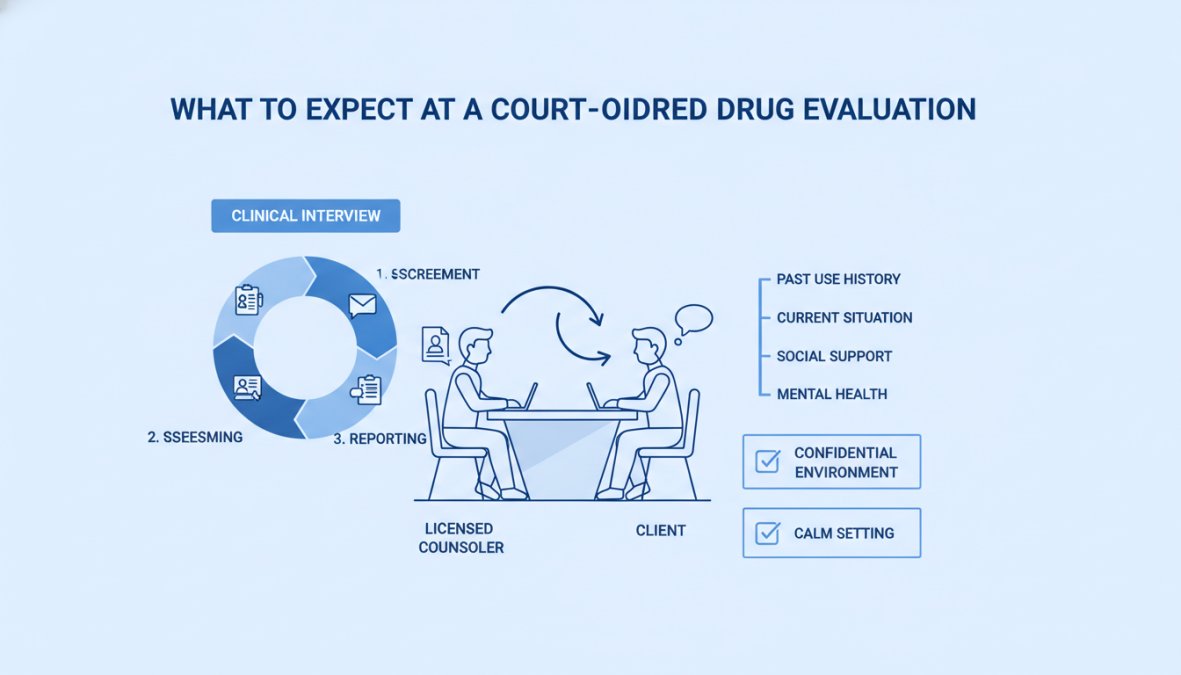
What to Expect at a Court-Ordered Drug Evaluation
The Clinical Interview Process
The clinical interview is the core of your evaluation. A licensed counselor will ask detailed questions about your substance use history, family background, mental health, employment, relationships, and legal situation.
What to Expect. You’ll be asked about:
- Age when you first used alcohol or drugs
- Frequency and quantity of use over time
- Consequences you’ve experienced (legal, health, relationship, employment)
- Previous treatment attempts
- Family history of addiction or mental health disorders
- Current physical and mental health status
Honesty is critical. Counselors recognize minimization or deception, and dishonest responses can result in a negative report that harms your case.
Bring documentation if available: previous treatment records, medical history, medications you’re taking. This helps the counselor build an accurate picture and speeds up the process.
Standardized Testing and ASAM Criteria
After the interview, you’ll complete standardized assessment tools measuring severity of substance use, risk factors, and readiness for treatment. The ASAM Criteria (American Society of Addiction Medicine) evaluates six dimensions: acute intoxication/withdrawal, biomedical conditions, emotional/behavioral conditions, readiness to change, relapse/continued use risk, and recovery environment.
What the Results Mean. Your assessment might recommend:
- No treatment needed (rare, usually for low-risk first offenders)
- Outpatient counseling (once or twice weekly)
- Intensive outpatient program (IOP) (multiple sessions per week)
- Residential treatment (overnight facility-based care)
- Inpatient hospitalization (for severe cases with medical complications)
The evaluator’s recommendation is clinical guidance. The judge decides whether to follow it, but treatment recommendations carry significant weight in sentencing and probation conditions.
Substance Abuse Assessment Sliding Scale and Payment Options
Sliding Scale Fees. Community mental health centers, nonprofit agencies, and some private counselors adjust fees based on household income and family size. Ask about sliding scale when you call to schedule.
Payment Plans. Many providers allow you to pay over time. A typical arrangement might be 50% at the appointment and 50% when you receive the report.
Public Funding. State and local substance abuse agencies sometimes fund evaluations for individuals involved in the legal system. Contact your state’s Department of Health or Substance Abuse Services.
Online Providers. Telehealth platforms like DrugEval.com often charge less than traditional clinics due to lower overhead.
| Payment Option | Typical Cost Range | Best For |
|---|---|---|
| Private practice, in-person | Higher range | Insured individuals |
| Community mental health center | Sliding scale | Lower-income individuals |
| Online provider (DrugEval.com) | Moderate range | Time-constrained individuals |
| Nonprofit agency | Sliding scale | Uninsured/underinsured |
Why Courts Require Substance Abuse Evaluations
Risk Assessment. An evaluation tells the judge whether you pose a risk to the community and whether substance use contributed to the offense.
Treatment Planning. The evaluation’s recommendations guide probation conditions and treatment requirements. If the evaluator recommends outpatient counseling, that recommendation often becomes a probation term.
Accountability and Rehabilitation. Courts use evaluations to demonstrate they’re addressing root causes while holding individuals accountable and providing a path to recovery.
How to Find a Court-Approved Provider and Prepare
Verifying Provider Credentials and State Licensing
Check Your State’s Licensing Board. Search your state’s Department of Health or professional licensing board to verify that your potential provider holds current credentials in addiction counseling, clinical social work, or psychology.
Verify Court Approval. Contact your local court’s probation department or the prosecutor’s office for a list of approved providers. Using an approved provider ensures your report will be accepted.
Check IC&RC Certification. The International Certification and Reciprocity Consortium (IC&RC) certifies addiction counselors across the United States. IC&RC certification indicates the counselor has met education, experience, and examination standards.
Ask About Experience. How many court-ordered evaluations has this provider completed? A provider with 10+ years and hundreds of evaluations brings credibility and thoroughness.
The best provider is licensed in your state, court-approved, experienced in court-ordered assessments, and transparent about fees and timelines upfront.
Preparation Checklist for Your Evaluation
Documents to Bring:
- Photo ID (driver’s license or passport)
- Insurance card (if applicable)
- List of medications you’re currently taking
- Previous treatment records or discharge summaries (if available)
- Court order or letter from probation officer
Information to Prepare:
- Timeline of your substance use
- List of consequences (legal, job loss, relationship damage, health issues)
- Family history of addiction or mental health disorders
- Current stressors and life circumstances
Practical Preparation:
- Schedule at a time when you’re well-rested and clear-headed
- Avoid using alcohol or drugs for at least 24 hours before the appointment
- Arrive 10-15 minutes early to complete intake forms
- Plan to be there for 2+ hours
What Happens if You Disagree With Evaluation Results
Request Clarification. Contact the evaluator and ask them to explain specific findings you don’t understand.
Seek a Second Opinion. You can request an independent evaluation from another court-approved provider. Discuss this with your attorney before pursuing a second evaluation.
Present Evidence to the Court. If you have documentation contradicting the evaluation, your attorney can present this evidence to the judge.
Comply While Appealing. Regardless of disagreement, complying with court orders while pursuing appeals protects your legal position. Non-compliance can result in additional charges.
Disagreeing with an evaluation is not grounds for ignoring it. Address disagreements through legal channels, not by refusing to participate.
Navigating a court-ordered substance abuse evaluation can feel overwhelming. The good news is that qualified providers exist in every state, many offer affordable options, and the process is designed to be fair and professional.
When you’re ready to schedule, DrugEval.com provides a simplified online platform connecting you with state-licensed counselors within 60 seconds of booking. Our evaluators hold IC&RC or affiliated board credentials, bring 5+ years of average experience, and deliver court-ready reports with fast turnaround times.
Start your evaluation today at https://drugeval.com/find-my-evaluation/ and take the first step toward meeting your legal obligations with confidence.
Frequently Asked Questions
How much does a court-ordered substance abuse evaluation typically cost?
Court-ordered substance abuse evaluation costs vary significantly based on location, provider credentials, and assessment complexity. Factors include whether the evaluation is in-person or virtual, the state’s regulatory requirements, and whether insurance covers the service. Many court-approved providers offer sliding scale fees based on income, and some offer flat-fee options for faster processing. Contact DrugEval.com at https://drugeval.com/find-my-evaluation/ to get a personalized quote based on your specific situation and location.
What happens during a court-ordered substance abuse evaluation?
A court-ordered substance abuse evaluation typically includes a clinical interview conducted by a state-licensed counselor, standardized screening tools, and a psychosocial assessment. The counselor reviews your substance use history, medical background, and legal circumstances. The evaluation follows ASAM criteria guidelines to assess the severity of any substance use disorder and recommend appropriate treatment. You’ll receive a formal evaluation report documenting findings and treatment recommendations, which is provided to the court or probation department as required.
How long does a substance abuse evaluation take from start to finish?
A typical substance abuse evaluation session lasts 60-90 minutes, though the total timeline depends on scheduling availability and report turnaround. Virtual evaluations through platforms like DrugEval.com can often be scheduled within 24-48 hours, while in-person appointments may take longer to arrange. The evaluation report is usually completed within 3-7 business days of your assessment. Same-day virtual options are available through some providers, making it possible to meet court deadlines quickly. Book your evaluation at https://drugeval.com/find-my-evaluation/ to confirm turnaround times.
What should I bring to my substance abuse assessment appointment?
Bring a valid photo ID, insurance card (if applicable), and any relevant medical or psychiatric records. Have a list of current medications and any previous substance abuse treatment history. Prepare information about your employment, legal history, and living situation. For virtual evaluations, ensure you have a private, quiet space and a reliable internet connection. Arrive early to complete intake forms if in-person.
Ready to book your evaluation?
It’s confidential and takes about 60 seconds to get matched to the right evaluation and a qualified substance abuse professional.
Find My Evaluation

