DOT SAP Process Explained for 2026: Step-by-Step Guide for CDL Drivers
The DOT SAP process is mandatory for CDL drivers who violate DOT drug or alcohol rules. To get back to driving, you must complete a series of steps involving a Substance Abuse Professional (SAP). Here’s the process in simple terms:
- Step 1: After a violation (positive test, refusal, etc.), you’re removed from safety-sensitive duties. Your employer reports the violation to the FMCSA Clearinghouse.
- Step 2: Schedule an evaluation with a DOT-qualified SAP. Services like DrugEval.com offer telehealth evaluations for $539 (standard) or $589 (expedited).
- Step 3: Complete the SAP’s recommended education or treatment plan based on your evaluation.
- Step 4: Attend a follow-up evaluation to confirm compliance and receive a Return-to-Duty (RTD) report.
- Step 5: Pass a DOT Return-to-Duty test and follow an unannounced testing plan (minimum of six tests in the first year).
Starting November 18, 2024, violations may also lead to CDL suspension in some states. Completing the SAP process is required to restore your driving privileges. Telehealth options make the process more convenient, especially for drivers on the road.
Act quickly to avoid delays. Gather necessary documents, prepare for evaluations, and stay compliant to return to work faster.
Prerequisites for Starting the SAP Process
Who Needs to Complete the SAP Process?
Any CDL driver performing safety-sensitive duties who violates DOT drug and alcohol regulations must go through the Substance Abuse Professional (SAP) process. Violations like positive drug or alcohol tests, refusals to test, or attempts to tamper with testing procedures trigger this requirement. This applies to drivers across all commercial driving categories, including trucking company drivers, bus operators transporting 16 or more passengers, HAZMAT endorsement holders, owner-operators, and drivers working for local, state, or federal agencies.
Safety-sensitive responsibilities also extend to tasks such as roadside inspections, hazardous materials handling, and operating equipment. Violations in these areas result in immediate removal from duty until the SAP process is completed. Employers must report these violations to the FMCSA Clearinghouse within 24 hours, which blocks the driver from resuming safety-sensitive work until they are officially cleared.
Required Documents and Information
Before scheduling your SAP evaluation, gather these key documents:
- A valid CDL
- Contact details for your current employer
- Details about the violation (e.g., test results or refusal reports)
- FMCSA Drug and Alcohol Clearinghouse login credentials
These credentials are essential for verifying your violation status in real time and ensuring your SAP evaluation results are reported to the federal database.
Additional documents to prepare include records of any past arrests or substance-related charges, your driving history (MVR) or DMV reports, toxicology or substance screening results from the past 12 months, and certificates from any completed treatment programs. If your employer has provided forms for the SAP to sign, have those ready as well. All these documents can be securely uploaded during the pre-appointment questionnaire phase on DrugEval.com.
Double-check your Clearinghouse access 24 to 48 hours before your appointment to avoid delays or rejected evaluations. If any violation reports are missing, contact your employer immediately, as documentation must be submitted within 24 hours. Once everything is ready, ensure your technical setup is prepared for the telehealth session.
Preparing for a Telehealth SAP Evaluation
For telehealth evaluations, make sure you have a device with a working webcam and microphone, a stable internet connection of at least 10 Mbps, and a quiet, private space. Test your setup ahead of time to avoid technical issues.
Download and test Zoom in advance, following its telehealth checklist to ensure everything runs smoothly. Proper lighting is important so your photo ID can be clearly verified during the session. Schedule your appointment during non-driving hours when you’re fully alert, as showing up impaired will lead to termination of the session, rescheduling, and possible additional fees. Also, create your DrugEval.com account ahead of time and securely upload all required documents through their encrypted questionnaire to streamline the process.
DOT SAP guidelines under 49 CFR Part 40 stress the importance of preparation. Being well-prepared ensures an accurate clinical risk assessment during your initial evaluation and helps avoid unnecessary delays in completing the process.
The DOT SAP Process: 5 Steps for 2026
Step 1: SAP Referral and Scheduling Your Evaluation
Once your employer reports your violation to the FMCSA Clearinghouse, you’re immediately removed from all safety-sensitive duties. Typically, your employer or Designated Employer Representative (DER) will provide a list of DOT-qualified Substance Abuse Professionals (SAPs). However, you can also search for one on your own using national directories or third-party consortiums.
Before scheduling, make sure the SAP is DOT-qualified, has up-to-date training, and follows FMCSA regulations. If you’re scheduling a telehealth evaluation with DrugEval.com, you’ll need to complete an online intake form, upload your ID and violation details, select a U.S.-based time slot, and pay the fee – $539 for regular processing or $589 for expedited service. Once that’s done, you’ll move forward with a thorough initial evaluation.
Step 2: Initial SAP Evaluation
The initial evaluation, conducted via secure video, usually lasts between 60 and 90 minutes. This session starts with verifying your identity using your government-issued ID and birth date, often cross-referenced with Clearinghouse records. Your SAP will gather detailed information about your substance use history, including the types of substances used, how often, and for how long. They’ll also review the circumstances surrounding your DOT violation, your medical and mental health history, any prior DUIs or violations, and your work background.
To assess your risk level, standardized tools like AUDIT or DAST are used alongside clinical interview questions. Based on this evaluation, the SAP will determine what you need – whether it’s education, a brief intervention, outpatient counseling, intensive outpatient treatment, or residential rehabilitation. In more complex cases, additional follow-up or clarification may be required. It’s important to attend this session sober and alert.
Step 3: Completing Your Education or Treatment Plan
Your SAP will develop a plan tailored to your clinical assessment, history, and the severity of your substance use, all while prioritizing public safety under 49 CFR Part 40 and DOT SAP Guidelines. For less severe cases, where there’s no substance use disorder diagnosis, education might be the only requirement. This could involve 6 to 12 hours of DOT-specific drug and alcohol education, online modules, or a short early-intervention program.
For higher-risk cases or those diagnosed with a substance use disorder, the SAP may recommend counseling, outpatient programs, or residential rehabilitation, depending on the severity of the situation. Additional support like AA/NA meetings, relapse-prevention classes, or mental health counseling might also be suggested if other issues are involved.
To complete the plan, you must actively participate and meet all discharge criteria. Be sure to gather written proof of completion – such as certificates, attendance logs, or counselor summaries – and upload these to your SAP’s secure portal (or have them sent directly). This documentation is crucial for your follow-up evaluation.
Step 4: Follow-Up Evaluation and Return-to-Duty Authorization
In the follow-up evaluation, your SAP will review all submitted documents, confirm your participation with providers if needed, and reassess your substance use, coping skills, and risk level. They’ll look for signs of meaningful progress, including behavior changes, insights into your violation and triggers, and a plan to stay compliant through ongoing support or monitoring.
If the SAP is satisfied, they’ll issue a written return-to-duty (RTD) report to your employer or DER. This report confirms your eligibility for a DOT return-to-duty test and outlines follow-up testing requirements. DrugEval.com handles this step via video, secure uploads, and messaging, then sends DOT-compliant reports electronically to your employer. Typically, this process takes 24 to 48 hours after your completion documents are submitted.
Step 5: Return-to-Duty Test and Follow-Up Testing Plan
Once cleared by your SAP, your employer will schedule a DOT 5-panel urine test (and alcohol test if applicable), performed under direct observation as required by 49 CFR Part 40. You must provide a specimen at the scheduled time, and a negative result is mandatory to resume safety-sensitive duties.
Failing or refusing the RTD test counts as a new violation, which means you’ll be barred from safety-sensitive work and must repeat the entire SAP/RTD process from scratch. Your SAP will also create a follow-up testing plan based on your risk level and treatment history, as outlined in 49 CFR Part 40, § 40.307. At least six unannounced follow-up tests are required in the first 12 months after your return-to-duty, though testing may extend up to five years. Your employer is responsible for scheduling these tests, while you must remain available and comply with every unannounced test.
Completing the RTD test successfully wraps up the SAP process, allowing you to return to safety-sensitive work. However, any new violation during this period could lead to removal from duty and require starting the SAP process all over again.
Telehealth SAP Evaluations with DrugEval.com
Benefits of Telehealth for CDL Drivers
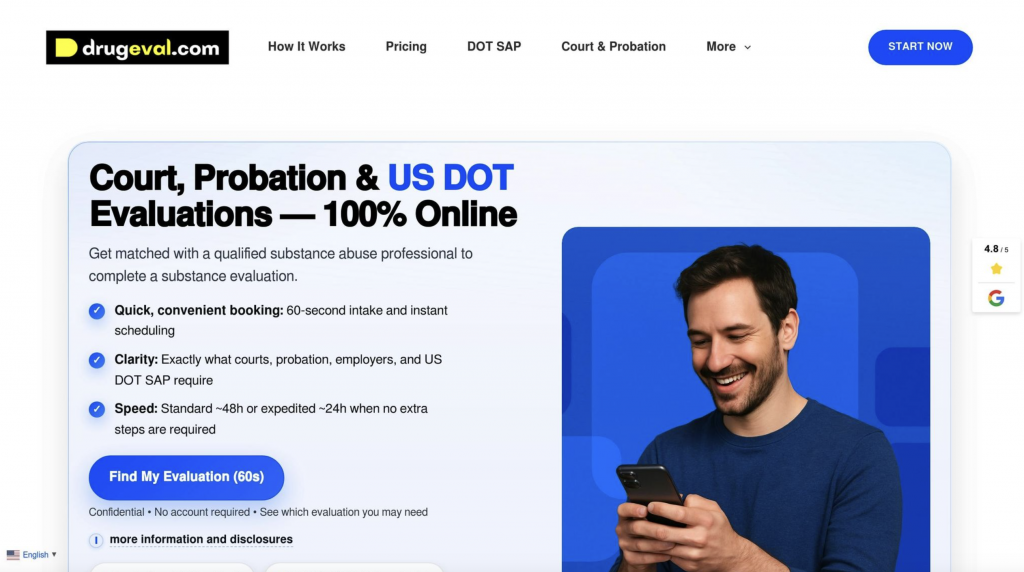
Telehealth SAP evaluations are a game-changer for CDL drivers. They eliminate the hassle of in-person office visits, which is especially helpful for drivers who are often on the road or live in remote areas with limited access to SAP providers. Instead of spending time and money on travel, lodging, and fuel, you can handle both your initial and follow-up evaluations from wherever you are – your truck, home, or any private spot with internet access.
DrugEval.com makes it even easier with fast and flexible scheduling options, including same-day or next-day appointments and availability during evenings or weekends. This flexibility means you can fit evaluations into your schedule without losing workdays or wages. Plus, the process fully complies with DOT regulations under 49 CFR Part 40, which allows secure video calls to count as “face-to-face” evaluations, provided your identity and privacy are verified. Next, you can explore the service options designed to meet your specific compliance and scheduling needs.
DrugEval.com’s SAP Evaluation Service Options
DrugEval.com offers two straightforward service tiers to help you meet compliance requirements without confusion:
- Regular DOT SAP Evaluation: This option provides compliance documentation within 48 hours of completing both the initial and follow-up sessions. It’s ideal if you’re not under tight deadlines and prefer to keep upfront costs lower.
- Expedited DOT SAP Evaluation: For those with urgent deadlines, this service guarantees documentation within 24 hours of completing both sessions. It also includes priority scheduling, often allowing same-day or next-day appointments.
Both options cover the full SAP process, including the initial evaluation, tailored treatment or education recommendations, follow-up evaluation, return-to-duty authorization, and direct reporting to your employer or the FMCSA Clearinghouse.
| Service Tier | Price | Documentation Turnaround | Best For |
|---|---|---|---|
| Regular DOT SAP Evaluation | $539 | 48 hours after both sessions | Standard timelines, no urgent deadlines |
| Expedited DOT SAP Evaluation | $589 | 24 hours after both sessions | Urgent employer/court deadlines, faster RTD |
DOT-Compliant Documentation and Confidentiality
DrugEval.com ensures your information stays secure and private throughout the entire process. All evaluations, intake forms, and documentation are handled through HIPAA-compliant, encrypted platforms. Reports are formatted to meet DOT standards and fulfill employer verification and Clearinghouse reporting requirements. Once you complete your follow-up evaluation, DrugEval.com sends your detailed return-to-duty report directly to your employer or Designated Employer Representative (DER). If your case involves legal proceedings, these reports are also accepted by courts and probation officers.
The secure, remote process allows you to complete evaluations from a private location, avoiding the discomfort of crowded clinics while still meeting every federal compliance requirement. Combined with their fast documentation turnaround, DrugEval.com ensures you stay on track with DOT compliance without unnecessary stress or delays.
Ready to book your evaluation?
It’s confidential and takes about 60 seconds to get matched to the right evaluation and a qualified substance abuse professional.
Find My EvaluationConclusion
The steps outlined above provide a straightforward path for returning to duty after a DOT drug or alcohol violation. Completing the DOT SAP process is non-negotiable. Until every required step is finished, returning to safety-sensitive work is not an option. This includes being removed from duty, undergoing an initial SAP evaluation to assess your risk, completing all recommended education or treatment, passing a follow-up evaluation, taking a negative return-to-duty test under direct observation, and enrolling in a follow-up testing program. This program spans 1 to 5 years and requires at least six unannounced tests within the first year.
As of 2026, the FMCSA Clearinghouse monitors each milestone and cross-references them with state licensing systems. Missing steps or delays could result in a CDL downgrade, loss of income, and additional compliance issues.
Acting swiftly is critical. The sooner you connect with a DOT-qualified SAP and schedule your initial evaluation, the faster you can begin the necessary education or treatment and work toward return-to-duty authorization. Telehealth options, like those offered by DrugEval.com, make it possible to complete evaluations remotely, saving time while meeting Part 40 requirements.
While a DOT violation is serious, it is not insurmountable. SAPs are trained to guide drivers through the process, ensuring they meet all requirements for a safe and compliant return to duty. Drivers who follow the outlined steps and maintain clear communication with all parties involved generally return to work more quickly.
Make sure you have all necessary documentation ready. Work with your employer’s Designated Employer Representative (DER) to schedule your return-to-duty test and update Clearinghouse records. It’s also a good idea to ask your SAP or telehealth provider for a detailed breakdown of costs, timelines, and what’s included, so you can plan accordingly.
If you’re currently dealing with a violation or a “prohibited” status in the Clearinghouse, take immediate action. DrugEval.com’s telehealth SAP evaluations offer fast scheduling, secure documentation, and direct reporting to employers. By completing each step accurately, adhering to testing schedules, and protecting your CDL, you can regain your safety-sensitive status and get back on the road.
FAQs
What happens if I don’t complete the DOT SAP process?
Failing to finish the DOT SAP process can lead to serious setbacks. You’ll be immediately taken off safety-sensitive duties, and your CDL could be suspended or even disqualified. This creates significant obstacles to returning to work in the transportation industry and might result in ongoing employment and licensing challenges.
On top of that, skipping the process can expose you to greater legal and financial risks since CDL drivers are required to comply with DOT regulations. Completing every step of the process is crucial to restoring your eligibility and staying aligned with federal guidelines.
What is the telehealth evaluation process for CDL drivers?
The process for CDL drivers to undergo a telehealth evaluation in 2026 is straightforward and designed for ease. It begins with scheduling a virtual appointment with a DOT-qualified Substance Abuse Professional (SAP). During this session, the SAP will examine your substance use history, evaluate your current circumstances, and create a tailored plan that might involve treatment or educational programs.
Once you’ve completed the recommended steps, a follow-up evaluation will be conducted. If cleared, you’ll proceed with a return-to-duty drug or alcohol test. Key parts of this process, such as the initial evaluation, can be completed through telehealth, provided they comply with DOT regulations.
What documents should I have ready before starting the DOT SAP process?
Before you dive into the DOT SAP process, it’s important to gather a few key documents. Here’s what you’ll need:
- Your Commercial Driver’s License (CDL)
- Recent drug or alcohol test results, including any positive findings
- Medical or treatment records related to substance use or any previous evaluations
Keeping these documents organized and within reach can make the process smoother and ensure you meet all DOT requirements.
Ready to book your evaluation?
It’s confidential and takes about 60 seconds to get matched to the right evaluation and a qualified substance abuse professional.
Find My Evaluation