.pulse-btn { display: inline-block; padding: 12px 28px; background-color: #0066ff; color: white; font-weight: bold; text-decoration: none; border-radius: 9999px; /* pill shape */ transition: transform 0.2s ease; animation: pulse 1.5s infinite; } .pulse-btn:hover { transform: scale(1.05); } @keyframes pulse { 0% { box-shadow: 0 0 0 0 rgba(0,102,255,.7); } 70% { box-shadow: 0 0 0 15px rgba(0,102,255,0); } 100% { box-shadow: 0 0 0 0 rgba(0,102,255,0); } } /* Optional: respect reduced motion */ @media (prefers-reduced-motion: reduce){ .pulse-btn { animation: none; } }


Drug and Alcohol Evaluations in 2026: What Courts, Probation, and Employers Now Expect
Drug and alcohol evaluations in 2026 are more structured and regulated than ever, with updated requirements for courts, probation programs, and employers. These assessments determine substance use patterns, compliance with laws, and necessary treatment steps. Key changes include:
- Court Requirements: Evaluations must be conducted by licensed professionals, include validated screening tools (e.g., MAST, DAST), and adhere to legal standards like ASAM Criteria. Reports must be detailed and submitted on time.
- Probation Programs: Reports now focus on reducing reoffending risks, using collateral data and treatment plans tailored to individual circumstances.
- Employer Compliance: DOT-regulated industries face stricter drug testing rules, including oral-fluid testing and digital recordkeeping. SAP evaluations are mandatory for failed tests.
- Telehealth Options: Virtual evaluations offer flexibility, faster processing, and privacy, meeting most court and employer standards.
Prepare by gathering required documents, being honest during assessments, and following treatment recommendations to meet legal or workplace conditions effectively.
What Courts Require for Drug and Alcohol Evaluations
In 2026, courts demand that drug and alcohol evaluations adhere to strict legal and clinical standards. These evaluations play a critical role in judicial decisions by detailing substance use patterns and recommending appropriate next steps. To be accepted, the evaluation must be conducted by a licensed professional, such as a Licensed Chemical Dependency Counselor (LCDC), a psychologist, or a certified Substance Abuse Professional (SAP) for cases involving the Department of Transportation (DOT). Reports from unqualified evaluators are outright rejected by the courts.
Evaluators rely on collateral data – such as police reports or medical records – to confirm the accuracy of self-reported information. The final report must include clinical findings, specific treatment recommendations, and evidence of compliance with state or federal regulations. In cases involving safety-sensitive positions, evaluations must meet the requirements of 49 CFR Part 40. Reports are typically submitted within seven days of the clinical interview. The following sections break down how these principles are applied during the evaluation process.
How Court-Ordered Evaluations Work
Court-ordered evaluations follow a structured, multi-step process designed to meet legal requirements. The process begins with scheduling an appointment with a state-approved evaluator. The assessment, which typically lasts 60 to 90 minutes, includes a detailed clinical interview that explores the individual’s substance use history, mental health status, and the circumstances of the legal incident. Evaluators also use standardized screening tools to assess the severity of substance use and recommend treatment levels based on the ASAM Criteria (4th Edition).
In most cases, a physical drug test – such as urine, hair, blood, or saliva analysis – is required to confirm recent substance use and support clinical findings. After completing the assessment, the evaluator prepares a formal summary report that outlines the findings, clinical observations, and specific recommendations. This report is submitted directly to the court or probation officer. Meeting submission deadlines is crucial to avoid delays.
Additionally, standardized screening methods are used throughout the process to ensure consistency and reliability.
Standard Screening Tools Used in 2026
Courts only accept validated, evidence-based screening tools that align with current clinical standards. The Michigan Alcohol Screening Test (MAST) and Drug Abuse Screening Test (DAST) remain widely used for general court-ordered evaluations. For DUI cases, many accountability courts rely on the DUI Risk and Needs Triage (DUI-RANT), a tool specifically designed to assess the risk of repeat offenses.
To support comprehensive treatment planning, evaluators also use tools like the Addiction Severity Index (ASI) and the SASSI-4 (Substance Abuse Subtle Screening Inventory), which help identify cases where individuals may underreport their substance use. Clinical diagnoses must align with DSM-5-TR criteria, and treatment recommendations should specify an ASAM level of care, ranging from Level I (Outpatient) to more intensive inpatient options.
“A clinical diagnosis has important legal ramifications since judges tend to rely on assessments to identify an offender’s needs and risks, and to determine the offender’s disposition.” – SAMHSA
Probation Program Requirements and Compliance
Probation programs have evolved, now requiring more thorough evaluations to align with court mandates. Officers rely on detailed reports that explain how specific treatments can lower the risk of reoffending. These evaluations use a biopsychosocial approach, examining biological, psychological, and social factors that influence substance use. This holistic perspective helps probation officers better understand each individual’s circumstances and set appropriate supervision conditions.
The move toward treatment-focused models has significantly changed how evaluations are conducted. For instance, California’s Proposition 36, approved on November 5, 2024, allows eligible defendants to enter treatment programs instead of facing incarceration, based on evaluation outcomes. These assessments have become a crucial part of diversion programs, determining whether a substance use disorder justifies rehabilitation as an alternative to traditional sentencing. Probation programs now require evaluations that not only confirm substance use but also guide personalized treatment plans.
Creating Reports That Probation Officers Accept
To meet probation standards, reports must be submitted in “probation-ready” PDF format via secure email or fax, ensuring the chain of custody is maintained. These reports should include a comprehensive overview of the individual’s substance use history, family background, and mental health, along with actionable treatment recommendations aimed at encouraging long-term behavioral changes.
Employer Requirements: DOT and Workplace Compliance
Employers managing safety-sensitive roles under Department of Transportation (DOT) regulations will face tighter regulations in 2026. For example, the Federal Motor Carrier Safety Administration (FMCSA) and Pipeline and Hazardous Materials Safety Administration (PHMSA) require a 50% random drug testing rate for commercial drivers, while random alcohol testing remains at 10% for most DOT agencies. This means that half of the covered employees in specific industries must undergo unannounced drug screenings annually.
Another major shift is the introduction of oral-fluid (saliva) testing, officially permitted starting December 5, 2024. This method is less invasive and delivers results quickly – usually within 24 to 48 hours. However, its widespread use depends on the operational readiness of two HHS-certified laboratories, projected to be available by late 2025 or early 2026. Employers should revise their drug-testing policies now to include saliva testing and ensure their collection staff is trained specifically for this method, as urine collection certifications don’t cover oral-fluid procedures.
Additionally, electronic recordkeeping is set to simplify compliance. A forthcoming PHMSA rule will allow electronic signatures and digital custody and control forms (eCCFs) for all DOT drug and alcohol testing records by 2026. This change not only reduces paper usage but also streamlines processes for Designated Employer Representatives (DERs), who oversee testing programs. Moreover, DOT-regulated employers must submit annual drug and alcohol testing data via Login.gov. These updates align with the broader compliance framework and stricter oversight discussed earlier.
FMCSA Clearinghouse Changes for 2026
One of the most impactful updates involves how state licensing agencies handle violations. Starting November 18, 2024, any driver listed as “prohibited” in the FMCSA Drug and Alcohol Clearinghouse will face immediate CDL suspension. State driver’s licensing agencies (SDLAs) will now directly use Clearinghouse data to revoke driving privileges until the driver completes the Return-to-Duty (RTD) process.
The Clearinghouse retains records of violations for five years or until the RTD process is completed, whichever is longer. In 2021, 104,800 commercial drivers had at least one drug or alcohol violation recorded. These regulatory changes emphasize the importance of thorough evaluations and compliance with DOT Substance Abuse Professional (SAP) standards.
DOT SAP Evaluations for Commercial Drivers
When a DOT-regulated employee fails or refuses a drug or alcohol test, they must be immediately removed from safety-sensitive duties and provided a list of DOT-qualified Substance Abuse Professionals (SAPs). The employee is required to undergo a face-to-face evaluation and follow the SAP’s recommended treatment plan to qualify for a Return-to-Duty (RTD) test. The SAP evaluations now incorporate the ASAM Criteria Fourth Edition, which takes a more comprehensive, individual-focused approach and includes a new Level 1.0 for monitoring long-term remission. Telehealth services have also made it easier for drivers, SAPs, and employers to stay connected throughout the process.
Once treatment is complete, drivers must pass a directly observed RTD drug test. Additionally, follow-up testing involves a minimum of six random tests within the first 12 months after returning to safety-sensitive duties. Employers are responsible for reporting successful treatment completion and negative RTD test results to the Clearinghouse to lift the driver’s “prohibited” status. While completing the SAP process allows drivers to regain eligibility, employers ultimately decide whether to rehire employees who have violated their drug and alcohol policies.
| DOT Agency | 2026 Random Drug Testing Rate | 2026 Random Alcohol Testing Rate |
|---|---|---|
| Federal Motor Carrier Safety Administration (FMCSA) | 50% | 10% |
| Pipeline and Hazardous Materials Safety Administration (PHMSA) | 50% | N/A |
| Federal Transit Administration (FTA) | 50% | 10% |
| Federal Aviation Administration (FAA) | 25% | 10% |
| Federal Railroad Administration (FRA) – Mechanical | 50% | 25% |
| Federal Railroad Administration (FRA) – Service/Maintenance | 25% | 10% |
Ready to book your evaluation?
It’s confidential and takes about 60 seconds to get matched to the right evaluation and a qualified substance abuse professional.
Find My EvaluationTelehealth Options for Drug and Alcohol Evaluations
Telehealth evaluations have made court-ordered, probation, and employer-mandated assessments more accessible, thanks to updated compliance protocols.
What Telehealth Evaluations Include
Telehealth platforms allow you to complete evaluations securely from home, which is especially helpful for people in rural areas, those with suspended licenses, or anyone who needs to minimize disruptions to their work schedule. The process closely mirrors traditional in-person evaluations. It begins with completing standardized screening tools like the AUDIT, DAST, or MAST online. After that, you’ll have a one-on-one session with a licensed or certified substance use professional via a secure, HIPAA-compliant video platform.
During this session, the clinician will review your substance use history, details of any incidents, and any documents you’ve uploaded, such as court orders, arrest records, or toxicology results. After the evaluation, the clinician prepares a formal report outlining their findings and treatment recommendations.
Reports are usually ready within 48 hours, but there’s an expedited option for 24-hour delivery if needed. These reports are designed to meet the standards of courts, probation officers, and employers. With your consent, they can even be sent directly to your attorney, probation officer, or employer to simplify the verification process. Below are the evaluation packages available to meet these needs.
DrugEval.com Pricing and Service Options
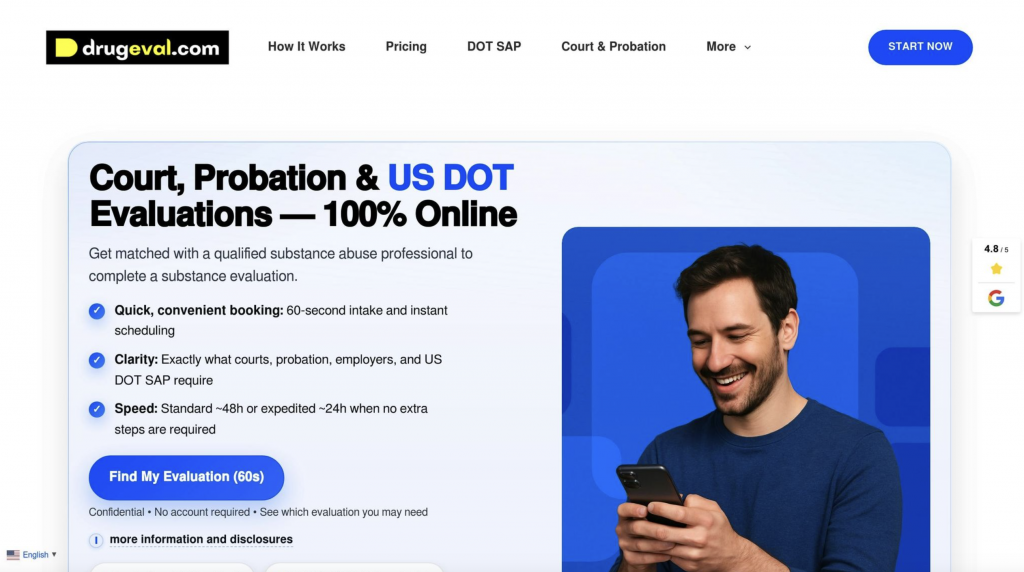
DrugEval.com provides four evaluation packages tailored to different requirements:
- Regular Evaluations ($199): Ideal for court orders, probation, DMV cases, or non-DOT workplace requirements. This package includes a secure video session with a licensed counselor, standardized assessments, and a detailed 9–10 page report, typically delivered within 48 hours.
- Expedited Evaluations ($249): Designed for urgent cases, this option includes everything in the regular evaluation but prioritizes processing for a 24-hour report delivery.
- Regular DOT/SAP Evaluations ($539): Specifically for commercial drivers and DOT-regulated employees who have failed or refused a drug or alcohol test. This package follows the federal Return-to-Duty process, including an initial assessment and a follow-up session. Reports are formatted to FMCSA Clearinghouse standards and are usually delivered within 48 hours of the second session.
- Expedited DOT/SAP Evaluations ($589): Similar to the regular DOT/SAP evaluation but offers a 24-hour turnaround for urgent compliance needs after the second session.
These options are widely accepted by courts, probation programs, and employers across most U.S. states. DrugEval.com has served over 2,500 clients and holds an impressive 4.0+ average rating from verified users.
Before purchasing, confirm with your court, probation officer, or employer that telehealth evaluations and the evaluator’s credentials are accepted. While DrugEval.com’s services are recognized in most states, Nebraska does not accept telehealth evaluations, and specific rules apply to DUI cases in Washington and Oklahoma. To speed up the process, have your court order, arrest records, and any prior treatment certificates ready for upload during the intake process.
How to Prepare for Your Evaluation
The Complete Evaluation Process
Before your evaluation, make sure you have all the necessary documents ready. This includes court papers, arrest reports (even for dismissed or expunged charges), specific court or probation orders, and, if it’s a workplace evaluation, employment-related notices. You’ll also need your ID, date of birth, contact information (phone and email), and any other relevant paperwork.
Be prepared to discuss your medical and psychiatric history, including details about current medications and any past treatments. It’s also helpful to have a quick summary of your education, employment history, and community involvement. These evaluations usually take about 45 to 60 minutes to complete.
Honesty is crucial. Evaluators use standardized screening tools to identify behavior patterns, so being upfront ensures the accuracy of your results. If you’re on any medications that might influence the outcome, bring copies of your prescriptions. This helps the Medical Review Officer (MRO) verify legitimate medical use and prevents false positives from being reported.
For telehealth evaluations, choose a quiet, private space to ensure confidentiality. Schedule your appointment early, and if you’re on a tight deadline, ask about expedited reporting options that can provide results within 24 hours.
After the evaluation, the final report will include tailored treatment recommendations based on your specific situation.
What Treatment Recommendations Mean
Once your evaluation is complete, the clinician will include treatment recommendations in the report. These recommendations are guided by the ASAM Criteria (Fourth Edition), which evaluates six key areas: your history of intoxication and withdrawal, physical health, mental health and cognitive conditions, risks related to substance use, recovery environment, and any personal barriers to care. The aim is to develop a treatment plan that is both person-centered and sensitive to any past trauma.
The recommendations can vary widely. They might include no further action, participation in educational programs, outpatient counseling, or even more intensive inpatient treatment. In 2026, these plans typically follow SMART objectives – specific, measurable, attainable, realistic, and time-bound. Following these recommendations is often essential for regaining privileges like driving, employment, or custody rights.
Courts and probation officers expect you to follow through with the recommended treatment. It’s important to note that the intensity of the treatment should match your risk level – overly intensive programs can sometimes have the opposite of the desired effect. Keep all certificates of completion and attendance records, as you may need to provide these as proof of compliance later on.
Meeting 2026 Standards with Confidence
As we step into 2026, drug and alcohol evaluations are guided by clearer and more structured expectations than ever before. Courts now rely on standardized tools like AUDIT and DAST, probation officers demand timely reports with specific recommendations, and employers – particularly those under DOT regulations – require documentation that aligns with federal guidelines. To meet these expectations, it’s essential to work with credentialed providers and prepare thoroughly.
Telehealth evaluations have become widely accepted across courts, probation programs, and workplaces nationwide, as long as the provider is licensed and the report includes proper identity verification and complete documentation. DrugEval.com has tailored its process to meet these updated standards. From secure online intake forms that capture court orders and probation requirements to standardized screening tools, detailed clinical interviews, and court-ready PDF reports delivered in just 24 to 48 hours, the system is designed to simplify the process. By eliminating guesswork, this approach ensures you meet legal deadlines, probation conditions, and DOT return-to-duty requirements efficiently.
The key to a successful evaluation lies in honesty and preparation. Being upfront during your clinical interview ensures that the report accurately reflects your circumstances, and any treatment or educational recommendations are tailored to your needs. Courts and employers value prompt action on recommended services, which can positively influence outcomes like sentencing decisions, probation reviews, and even job security.
If you’re working under tight deadlines or dealing with missing documents, staying organized is crucial. Gather all necessary paperwork – such as court orders, arrest records, treatment summaries, probation terms, or employer notices – before your appointment. Telehealth evaluations offer a faster alternative to in-person visits, with DrugEval.com providing expedited reports within 24 hours. Upload your documents in the required format and ensure your evaluator addresses all critical points in their report. This proactive approach saves time, avoids duplicate evaluations, and keeps you on track even when challenges arise.
With transparent pricing – $199 for a standard evaluation and $249 for expedited service – and a process designed to meet today’s court, probation, and workplace expectations, you can move forward with confidence. Gather your paperwork, schedule your telehealth evaluation, and take the next step toward resolving your requirements effectively.
FAQs
What are the updated court requirements for drug and alcohol evaluations in 2026?
In 2026, courts introduced new standards for drug and alcohol evaluations within treatment court programs. These evaluations are now required to be carried out by licensed addiction and mental health professionals, ensuring they meet the highest standards for accuracy and effectiveness.
The updated guidelines, set by the Judicial Council, focus on gaining a deeper understanding of an individual’s substance use and mental health challenges. This allows courts to create personalized treatment plans and compliance strategies that align with the latest developments in addiction and mental health care.
What are the differences between telehealth and in-person drug and alcohol evaluations?
Telehealth evaluations offer a level of convenience, accessibility, and privacy that’s hard to beat. With just an internet connection, individuals can complete assessments from virtually anywhere – whether they’re in a remote location or juggling a packed schedule.
That said, while telehealth is an effective option in most cases, it does have its limitations. In-person evaluations can sometimes pick up on subtle physical or behavioral cues, like body language, that may not be as easily observed through a screen. For situations where these nuances are critical, an in-person approach might still be the better choice. Even so, telehealth continues to grow and remains a reliable option for a wide range of needs.
Ready to book your evaluation?
It’s confidential and takes about 60 seconds to get matched to the right evaluation and a qualified substance abuse professional.
Find My Evaluation