Do I Need a Drug and Alcohol Evaluation After a DUI? Step-by-Step
If you’ve been charged with a DUI, a drug and alcohol evaluation is often required by courts or the DMV. This assessment determines the extent of substance use issues and impacts sentencing, probation, or license reinstatement. Here’s what you need to know:
- What It Is: A 45-60 minute session with a licensed counselor using tools like AUDIT or MAST.
- Why It’s Required: Courts use it to assess risk levels (Minimal to High) and recommend treatment or education programs.
- Cost: Typically $150-$400, paid by the individual.
- When It’s Needed: After a DUI conviction, during probation, or for license reinstatement. Voluntarily completing one early can positively affect plea deals or sentencing.
To complete the evaluation:
- Confirm court/state requirements.
- Gather documents like arrest details, driving history, and legal paperwork.
- Schedule an evaluation with a licensed provider (e.g., DrugEval.com).
- Attend a video or in-person session sober and prepared.
- Submit the report and follow recommendations.
Online services like DrugEval.com offer fast, court-accepted evaluations with reports delivered in 24-48 hours. Costs range from $199 (standard) to $249 (expedited). Always check if telehealth evaluations are accepted in your state.
When You Need a Drug and Alcohol Evaluation
State-Specific Legal Requirements
In many states, a drug and alcohol evaluation is a mandatory step after a DUI conviction, though the specifics – like timing and procedures – depend on where you live. For example, in North Carolina, individuals charged with impaired driving must complete a substance abuse assessment before the DMV will reinstate their license.
California’s system ties evaluation requirements to treatment program lengths. First-time DUI offenders typically complete a 3-month program, while repeat offenders might face programs lasting up to 30 months. Despite these differences, the shared aim across states is clear: identifying substance use issues to design appropriate interventions for DUI cases.
Court Orders and Personal Decisions
Legal mandates aren’t the only reason you might need an evaluation. Courts often require them as part of probation conditions. If you’re participating in a DUI diversion program or entering “DUI court”, an evaluation will likely be a required step.
Sometimes, getting ahead of the process can work in your favor. Voluntarily completing an evaluation before the court orders it can send a strong signal of accountability. Defense attorneys often advise clients to take this proactive step early in the legal process. As Justia explains, “If you voluntarily submit to assessment and treatment as necessary, this can be brought up to sway the prosecutor in plea negotiations”. An early evaluation, especially one that shows minimal risk or no signs of abuse, can positively influence plea agreements or sentencing outcomes.
How to Complete Your Drug and Alcohol Evaluation: 5 Steps
Step 1: Confirm Your Case Requirements
Start by carefully reviewing your court documents to understand what type of evaluation is required and how to submit it. Typically, your court order, probation paperwork, or referral forms will outline these details. If anything seems unclear, reach out to your attorney or probation officer for clarification. For example, ask whether telehealth evaluations are allowed in your jurisdiction and what specific documentation is needed.
Keep in mind that some states have unique restrictions. For instance, Nebraska may not accept telehealth evaluations for certain cases, while Washington and Oklahoma have specific rules for DUI-related evaluations. Double-checking these details upfront can save you time and money by ensuring you meet the necessary legal requirements.
Once you’ve confirmed everything, you’re ready to schedule your telehealth evaluation.
Step 2: Choose DrugEval.com for Your Evaluation
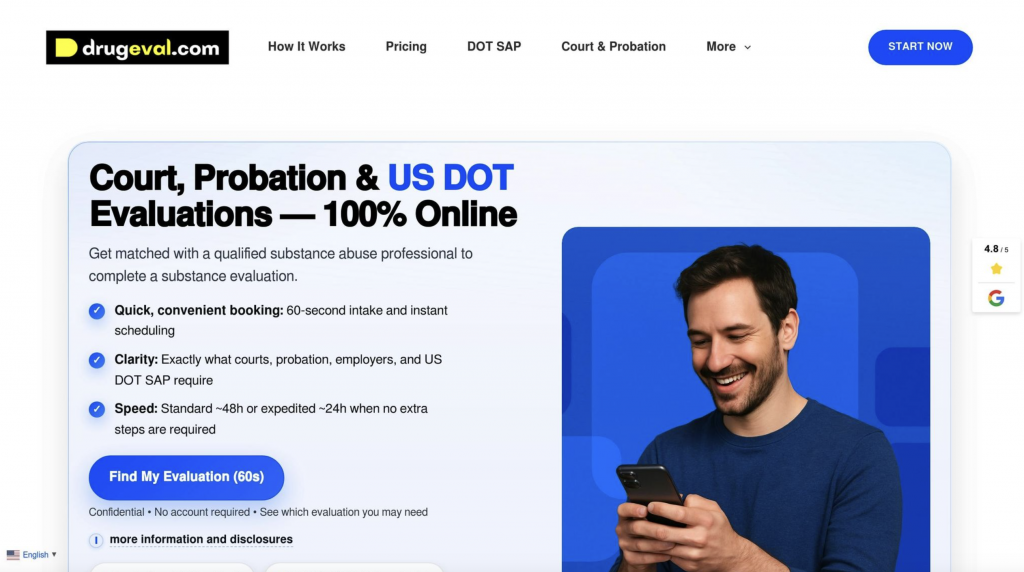
DrugEval.com provides a convenient and easy-to-use online service, eliminating the need to visit a physical clinic. Their evaluations are widely accepted by courts, probation officers, and attorneys across most states. Plus, they deliver reports quickly – within 24 to 48 hours, depending on the service level you select.
The process is simple: the intake form takes just about a minute to complete, and you can schedule your video session immediately. Licensed counselors use the same standardized tools as in-person evaluators, ensuring your report meets all legal requirements.
Step 3: Prepare for Your Appointment
Before your session, gather all the necessary documents. Here’s what you’ll need:
- Arrest Details: Include your arrest report, incident details, tickets, sentencing sheets, and the officer’s report.
- Driving History: A 7-year Motor Vehicle Report (MVR) or a DMV printout.
- Legal Documentation: Court orders, probation paperwork, or referral forms.
- Prior Progress: Certificates from DUI school or completed treatment programs.
- Medical Records: Recent toxicology or drug screen results (within the last 12 months).
- Collateral Contacts: Names and contact information for 2–3 people who can provide insight into your substance use history.
| Documents | What You Need |
|---|---|
| Arrest Details | Incident report, tickets, sentencing sheet, officer’s report |
| Driving History | 7-year MVR or DMV printout |
| Legal Status | Court orders, probation documents, referral forms |
| Prior Progress | DUI school certificates, treatment completion certificates |
| Medical | Toxicology or drug screen results from the last 12 months |
Complete any online forms and encrypted questionnaires provided by DrugEval.com before your session. Also, make sure to download the Zoom app and check your camera and internet connection in advance.
Step 4: Attend Your Video Session
Your video session will typically last between 60 and 90 minutes. Make sure you’re in a quiet, stationary location – sessions may be canceled if you’re driving or in an unsafe environment. During the session, a licensed counselor will conduct a clinical interview covering your substance use history, lifestyle factors, and the circumstances of your arrest. They’ll also use standardized screening tools to assess your risk level and determine the best recommendations.
Be sure to attend the session sober. Showing up under the influence could result in rescheduling fees and delays in receiving your report. Answer all questions honestly; evaluators are trained to spot inconsistencies, which helps ensure an accurate assessment.
“My evaluation was as painless as one can be. [My counselor] was very timely and efficient… He was polite and professional and I feel like he didn’t pass any judgment.” – Jarrett
Once your session is complete, you’ll move on to reviewing your report and following the recommendations provided.
Step 5: Receive Your Report and Follow Through
DrugEval.com provides a court-ready PDF report within 48 hours for standard service or within 24 hours if you opt for expedited service. This report will include your risk classification – Minimal, Moderate, Significant, or High – based on factors like your blood alcohol concentration (BAC), arrest history, and screening results.
The report will also outline any next steps you need to take. These could range from attending a one-day education class to enrolling in a long-term rehabilitation program. Keep in mind, these recommendations are separate from the evaluation fee, so plan your budget accordingly.
Once you receive your report, submit it to the court, your probation officer, or the DMV as instructed. If treatment is recommended, make sure to complete all required sessions. This is often necessary to reinstate your license or fulfill probation terms.
Ready to book your evaluation?
It’s confidential and takes about 60 seconds to get matched to the right evaluation and a qualified substance abuse professional.
Find My EvaluationDrugEval.com Pricing and Service Options
Managing post-DUI requirements means understanding both your costs and timeline. Let’s break down DrugEval.com’s pricing and service options to help you plan effectively.
DrugEval.com charges a one-time fee – there are no subscriptions or auto-renewals. All services are self-pay, as insurance is not accepted or billed. This fee includes a clinical interview with a licensed counselor and a court-ready PDF report. However, it doesn’t cover additional expenses like substance testing, recommended treatment classes, or state filing fees.
For those with tight budgets or deadlines, third-party payment plans are available. These plans allow flexibility, but you’ll need to review the provider’s terms carefully, as interest or late fees may apply depending on the chosen plan. Knowing these details can help you budget for your evaluation process.
Service Options: Regular vs. Expedited
DrugEval.com provides two service speeds to fit your timeline: Regular and Expedited. With Regular service, you’ll receive your report in about 48 hours. Expedited service, on the other hand, prioritizes your case and delivers the report in roughly 24 hours. Both options include the full evaluation process – the only difference is how quickly you’ll get your results.
Opting for the Expedited service costs an additional $50 and ensures faster delivery. Keep in mind that delivery times begin after your appointment and submission of all required documents. This flexibility allows you to choose the option that best matches your urgency.
| Service Type | Regular Price | Expedited Price | Delivery Time |
|---|---|---|---|
| Drug & Alcohol Evaluation | $199 | $249 | ~48 hours / ~24 hours |
| DOT SAP Evaluation | $539 | $589 | ~48 hours / ~24 hours* |
*DOT SAP evaluations require two sessions. Delivery time starts after both sessions are completed.
How to Navigate Your Evaluation Successfully
Getting through your evaluation smoothly requires being upfront and planning how you’ll handle the costs. The following advice works hand-in-hand with the step-by-step process already outlined.
Answer Questions Honestly
Evaluators often rely on tools like the Alcohol Use Disorders Identification Test (AUDIT) or the Drug Abuse Screening Test (DAST) to determine your risk level. These levels are typically categorized as Minimal, Moderate, Significant, or High. Your honesty is key here, as your answers influence both sentencing outcomes and any treatment recommendations. If you’re unsure about a question, it’s better to admit it rather than make a guess. Keep your responses short, accurate, and to the point.
To prepare, take some time to review the details of your arrest and your history with alcohol or other substances. This will help you provide consistent and clear answers. Also, make sure you show up to your session sober. Arriving under the influence – or even hungover – could lead to the evaluator ending your session and rescheduling it, which might cost you extra fees.
Understand Your Payment Choices
Evaluations are typically self-funded, so it’s important to plan ahead. If you’re unable to cover the cost upfront, consider looking into third-party payment plans. Additionally, choose between Regular or Expedited services based on how soon your court deadline is. Assess your payment options carefully and select the service that aligns with your timing needs.
Conclusion
A drug and alcohol evaluation plays a key role in determining sentencing, probation terms, and the reinstatement of a driver’s license after a DUI.
Opting for DrugEval.com offers a convenient solution. With online evaluations, you can skip in-person visits and work directly with licensed counselors. Reports are typically delivered within 24 to 48 hours, depending on whether you choose the Regular ($199) or Expedited ($249) service. The platform has already assisted over 2,500 clients and boasts a 4.0+ rating on Google.
Once you receive your report, acting quickly on the recommendations is crucial to meeting legal requirements. For instance, a minimal-risk assessment might only require a one-day educational course, while higher-risk evaluations could involve more extensive therapy. Be sure to keep copies of all certificates and compliance documents to share with your attorney or probation officer. Following through on every recommendation is essential to staying on track.
Before scheduling, confirm that your court or DMV accepts telehealth evaluations, especially if your state has specific guidelines. Prepare all required documents, such as a valid photo ID, court abstract, and arrest records. Make sure to attend your session sober to avoid rescheduling fees or negative feedback on your evaluation.
FAQs
What determines the cost of a drug and alcohol evaluation?
The price of a drug and alcohol evaluation depends on several factors. One major consideration is the purpose of the evaluation – whether it’s court-ordered, DOT-compliant, or for personal use. State or local requirements can also influence the cost, particularly if extra services like lab testing are needed.
Another key factor is the format of the evaluation. Online evaluations might provide more convenience and flexibility compared to in-person sessions, but costs can vary between the two. It’s important to review the specific requirements for your situation to get a clearer idea of potential expenses and available payment options.
How can completing a drug and alcohol evaluation help with DUI sentencing?
Taking the step to undergo a drug and alcohol evaluation ahead of your court date can signal responsibility and a commitment to addressing potential concerns. Judges often appreciate this kind of proactive approach, which might lead to more lenient outcomes – like reduced probation periods, less demanding treatment plans, or even access to diversion programs.
By demonstrating accountability and a willingness to cooperate, you not only improve your chances of receiving a more favorable sentence but also pave the way for a more straightforward resolution to your case. Getting the evaluation done early can significantly influence how your DUI case is addressed in court.
Are online drug and alcohol evaluations accepted for DUI cases in every state?
Online drug and alcohol evaluations aren’t universally accepted for DUI cases across all states. For instance, states like California permit telehealth assessments to fulfill court or probation mandates. However, some states insist on in-person evaluations conducted by state-approved providers. The rules around this can differ widely depending on where you are.
To avoid any confusion, it’s crucial to verify your state’s specific requirements. Reach out to your attorney, probation officer, or the court managing your case to confirm if an online evaluation is an acceptable option.
Ready to book your evaluation?
It’s confidential and takes about 60 seconds to get matched to the right evaluation and a qualified substance abuse professional.
Find My Evaluation